Posts

Showing posts with the label Working at Height

The Top Safety Challenges Of Your ISO Container Fleet: Part 3

Image
When your employees load and unload ISO containers at your facility, workplace safety is a top concern. Without the proper safety equipment, workers are at risk of serious incidents that may cause injuries or even fatalities. In blogs one and two of this three-part series, we highlighted specific isotainer safety challenges, including a wide variety of ISO container configurations and a lack of standard safety protocols. In the final blog of this series, we offer safety solutions to help your company protect employees who load and unload ISO containers: Incorporate An Elevating Platform With all the possible configurations and loading scenarios your workers could encounter when handling ISO containers, it’s unlikely your existing loading platforms and other safety equipment have the flexibility to provide safe access in all situations. Railings and safety platforms provide protection from some types of falls, but most loading platforms aren’t able to prevent workers from falling t...

The Top Safety Challenges Of Your ISO Container Fleet: Part 2

Image
In the 1990s, ISO containers were fairly rare, outside of coastal areas. With the rise of global corporations and international shipping, they have become a common solution for industrial transportation. Once used primarily to transport chemicals overseas to Singapore, China and other destinations, fleets of isotainers and seatainers now supply many facilities within the United States. The growing popularity of ISO containers also presents new industrial safety challenges for companies and their workers. That means it’s more important than ever to provide safe access for loading and unloading this equipment. In blog two of this three-part series, learn more about a critical workplace safety concern associated with handling isotainers: Undefined Loading And Unloading Procedures On the most basic level, loading and unloading ISO containers sounds straightforward. Specially made forklifts move ISO containers to the loading area, where large cranes move them and stack them onto ship...

3 Ways To Improve Fall Prevention At Your Facility

Image
If your company has taken safety precautions against workplace accidents, it is disconcerting when your workers experience close calls. Employees who fall and injure themselves are likely to miss work for a period of time, or even worse, become disabled. Safety precautions you implemented in the past are not always sufficient when your work environment changes. You need to continually assess, set goals and seek guidance on your workplace safety strategy. The following three best practices help you minimize the risk of dangerous falls at your facility: 1. Assess Your Site’s Current Fall Prevention Capabilities The first step toward building a culture of workplace safety is conducting an honest evaluation of your current fall prevention measures. Ask an impartial expert at your company or an outside advisor to identify the following aspects of your work site: Safety equipment that is currently in place Shortcomings of your equipment, such as a safety cage that makes completing a tas...

Understanding the Hierarchy of Fall Protection

Image
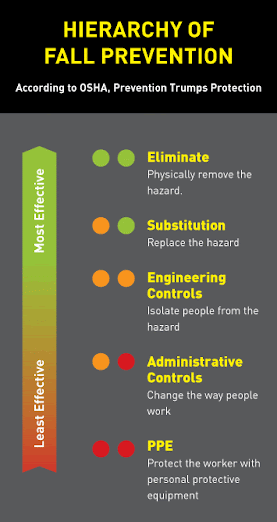
The Hierarchy of Fall Protection in Layman's Terms   Working at height can be hazardous and requires special equipment. Many governing bodies such as ANSI and OSHA set guidelines and regulations for these jobs, which may increase safety. Elimination (Stay on the Ground) Working at heights is a necessary aspect of many occupations yet can pose unique safety concerns. Therefore, it's vital that workers familiarize themselves with all available forms of fall protection systems and how they can be used to keep operators safe while performing their duties. Both ANSI and OSHA's Hierarchy of Hazard Controls state the initial step should be eliminating falling hazards from work environments - this means changing working environments, so employees aren't exposed to fall hazards to begin with, such as moving machinery onto the ground instead of the roof. While eliminating falls would always be preferable, sometimes this option simply isn't possible or could increase...

Industrial Equipment Maintenance Key to Protecting Empoyees

Image
How Important Is Equipment Maintenance in Terms of Industrial Safety?   Equipment maintenance enables businesses to operate smoothly. It reduces downtime, saves money, and ensures that projects are completed on time. Since small problems can cause big issues, leading to expensive downtime and missed deadlines, detailed equipment checklists help technicians monitor and spot problems early on. Equipment operators who see the machines every day tend to be the best at spotting potential issues. They can bring them to the attention of their managers for timely intervention. Preventative Maintenance From hand tools to power equipment, even small mistakes in maintenance can lead to dangerous situations that could potentially cause a loss of life. In fact, the Occupational Safety and Health Administration reports that workplace accidents are linked to inconsistent or inadequate maintenance standards. Putting off equipment maintenance may seem like a good idea at the time, but i...

Your Safety Plan and Fall Rescue Strategy - Important Tools For Worker Safety

Image
There are several professions that do not include the risk of being exposed to hazardous chemicals, heavy machinery, or substantial heights. However, it is vital that appropriate fall protection be put into place for employees who work at heights. OSHA is of the opinion that fall protection strategies are essential because falls are the most common cause of serious injuries and fatalities in the workplace. Fall protection plans are tactics that businesses put into place to maintain workers' safety in potentially dangerous industrial settings. These plans are designed to comply with OSHA rules as well. Fall protection plans identify the areas of concern as well as the appropriate safety equipment and supplies that are required to accomplish the task. This is especially helpful for smaller firms that may not have safety supervisors or the means to employ a safety consultant. On top of the plan, all workers who work on these locations that pose particular risks need to be trained in...

Improve Throughput and Keep Workers Safer

Image
Assessing Your Workplace for Overall Safety Keeping your workers safe while loading and unloading trucks is one of those things that can keep you up at night—or at least, the worry of what could happen if unsafe conditions are not addressed. Working at heights presents a wide range of potential safety hazards. Improperly secured materials or equipment can fall and injure workers. Fast-paced environments that require moving materials quickly and efficiently can put workers at risk of serious injury or death from falling. Creating a safe workplace starts with an overall safety assessment to determine if you are doing everything you can to keep workers safer. Over time, loading patterns, vehicles or equipment, and personnel may change, which can impact operations and the safety of workers. Once you know where you are at, you can update your system or build the right fall protection system for your specific environment and operation. The Height of Worker Safety Keeping workers safe w...

Is Your Loading Rack Getting the Job Done?

Image
  Loading Platform Safety Assessments Loading racks are a key component of a comprehensive worksite safety program. A loading platform safety system —with gangways, safety cages, and loading platforms designed to meet the specific needs of your environment and access requirements—not only keeps workers safer, but keeps operations running smoothly and on time. No matter what the material is being loaded or unloaded, workers should be protected and thoroughly instructed on safe-handling procedures. Protecting against falls with the right loading rack system can help prevent costly injuries and OSHA fines. How effective is your loading rack? While they don’t have an expiration date, considerations include: The age of the loading platform system Changes in loading patterns or access requirements Worker awareness of what the original equipment was designed to do Loading Rack Safety Assessments offer in-depth analysis and insight into whether your equipment is still doing the j...

Fall Protection Safety Specialists

Image
When it comes to the important things, like health and safety, you want someone with the knowledge and expertise to help cut through the sales and marketing noise and gain clarity around what is most productive.  There are a lot of companies out there that manufacture fall protection equipment. At first glance, it may appear they are fairly equal in terms of the products they sell. But when you do a deeper dive, how many are focused on the bigger picture and the many factors necessary to ensure a safer work environment? Topping the lists are: The right equipment Proper training Regular maintenance Having developed solutions for truck, rail, and marine applications around the world, Sam Carbis Solutions Group has encountered every challenge imaginable. Through our experience, we have learned to quickly assess what is important and identify the most effective solution for a company’s individual situation. The Best Solution The firm asked Sam Carbis Solutions Group to de...

A Unique Angle on Safety

Image
As the innovator of unique safety solutions across a host of industries, Sam Carbis Solutions Group is well versed in tackling complex safety challenges. A construction company was doing routine maintenance work on railroad trestles and found that a steep embankment was creating a safety hazard for workers. They came to Sam Carbis Solutions Group seeking a solution that would allow workers to safely move up or down the embankment as they performed their work. To further complicate the challenge, the embankment and angle of the slope varied in height. In addition, the company needed to be able to move heavy equipment from one location to another along the embankment, requiring a flexible solution. The team assessed the situation and came up with a custom solution, an Embankment Ladder. The ladder’s treads can be articulated to a flat position, providing a safer path up and down the embankment. The self-leveling stair is highly versatile and can be used on very steep or very shallo...

The OSHA Audit: A Brief Guide to Preparing for and Passing Inspections

Image
OSHA audits aren’t the only reason you should safeguard your site against accidents . Your workers’ safety is a priority, and the right solutions help them work more efficiently. However, OSHA fines and their impact on your budget shouldn’t be downplayed. Your facility must be prepared for an inspection. During a visit to your site, an OSHA representative will determine whether you are complying with the agency’s standards for a safe and healthful workplace. OSHA professionals have comprehensive training in safety and industrial hygiene. Why OSHA May Audit Your Site OSHA needs to choose carefully what sites it visits in order to provide maximum protection for American workers. If your facility presents an urgent risk, you’re more likely to receive an OSHA audit. The agency prioritizes its visits  in the following order: 1. Imminent danger – When OSHA is reasonably certain that danger exists at your site and may cause death or serious physical harm, it inspects your facility firs...

Three Approaches to Evaluating Your Safety Equipment Needs

When choosing safety equipment for your facility, the stakes are far too high to trust a one-size-fits-all approach. Perform A Job Safety Analysis Or Job Hazard Analysis Identifying your safety equipment needs starts with assessing your facility’s safety concerns, including any concerns that could arise in upcoming initiatives. To gather this evidence, conduct a standard step-by-step job safety analysis or job hazard analysis (JHA) . If you face particularly complex or dangerous safety risks, OSHA recommends several in-depth methodologies .  By gathering empirical evidence about safety hazards, you’re able to show measurable justifications for each of the safety issues you’ve identified. For example, you might use the number of breakdowns in the plant over a month as evidence of a specific safety issue. Focus On Value, Not Cost When evaluating your safety equipment needs, it’s important to look beyond the cost of solving problems and consider how your facility could benefi...

Close the Gap to Keep Workers Safer and Products Flowing

Image
Safety in the workplace does not have to be complicated. Investing in newer equipment—such as fully-encased crash boxes that provide full fall protection—and providing regular safety training ensure a safer working environment and reduce the risk of fall-related injuries. Slips, trips, and falls (STFs) are also costly and can result in lost productivity, increased insurance premiums, and the need to train replacement workers. Creating a safer workplace can sometimes be as simple as a periodic review of safety procedures, proper maintenance of safety equipment, and regular employee training. Often times, employees’ roles change, and newer employees may not be trained in the proper handling or placement of equipment. For example, a worker new to a position may line a truck up a few inches off from where it needs to be, creating a dangerous safety hazard. The necessity for conducting regular safety reviews and remediating hazards was made intensely clear by an incident at a facility th...

Mitigating Liquid Terminal Access Hazzards

Image
What constitutes creating safe access to liquid terminal platforms and equipment has evolved dramatically in recent years. In the not-too-distant past, workers may have simply climbed a railcar for access, creating a worse-case risk scenario. “Fall protection” then advanced to incorporating a ramp to reach a railcar, and possibly a protective cage. Changing requirements have also impacted modern fall protection practices. In 2016, OSHA updated industry standards, requiring the regular inspection and maintenance of walking-working surfaces, and training of workers on fall and equipment hazards. As newer, more comprehensive liquid terminal fall protection solutions have emerged, the limitations of conventional ramps and cages have become more evident, with more and more railway companies seeking full fall protection systems.   Elevated Railway Cages for Full Fall Protection   Today, elevated railway cages are the gold standard for liquid terminal fall protection. Unlike ab...

Tarping and Truck Safety: Training your Drivers and Operators

Covering a flatbed load to protect it during transit is a common task for drivers and operators, and one that presents serious truck safety challenges. Avoiding Back Injuries Lifting heavy tarps onto flatbed trucks and pulling them to cover the load puts strain on the lower back and shoulders, and is a major concern in flatbed trucking. Back injuries from lifting and pulling tarps could result in permanent disability for truck drivers as well as workers’ compensation claims of over $500,000, according to KeepTruckingSafe.com , a resource provided by the state of Washington’s Bureau of Labor and Industries. The website includes an interactive tarping simulation as well as case studies that examine these truck safety concerns. One way to prevent these injuries is to use an overhead tarping system that lifts and spreads the tarp over the flatbed. The operator simply connects the tarp to the spreader bar, which is suspended from an overhead track. Using a powered winch system and h...

Two Pressing Marine Safety Challenges Your Facility Can't Ignore

In comparison to other shipping vehicles, marine vessels are perhaps the most difficult to secure. Workers are at greater risk of falls and accidents because ships are in constant motion. Add changing tides to the equation, and providing safe access becomes even harder. Despite the challenges, improving marine safety offers significant benefits. Your workforce will be more surefooted on steady marine gangways with handrails , improving loading and unloading efficiency. Other forms of marine safety equipment, such as ship towers, make it easier to access vessels of any height. As you consider your current ship and dock safety measures, ask yourself whether your systems address the following two marine safety challenges: 1. Difficulty Boarding Barges and ships generally come to your facility for one of two reasons: to load or unload. Docks are outfitted well for loading devices to attach to the ship. However, you have to figure out how to get on and off the vessel. This is the risky pa...

How To Improve The Safety Of Your Rail Transloading Process

Transloading between trucks and rail cars helps you lower transportation costs through affordable rail shipping, even if your origin site or destination is not along a rail line. However, the process of tank rail car loading  and unloading can be dangerous. For example, workers may become lightheaded and faint if they inhale fumes from petroleum fuels. The manual labor involved in loading and unloading also presents a danger. Without proper equipment to improve the ergonomics of a task, workers may receive repetitive strain injuries. Then, there’s the matter of the tank cars themselves. Workers may fall from a height if they climb on top and trip. Unsecured cars may also move unexpectedly and strike workers on the tracks. While safety risks like these can’t be eliminated entirely, you can mitigate them. Learn more about how to protect your workers during rail transloading. Follow Rail Transloading Safety Procedures The Federal Railroad Administration has certain rules  in pl...

Are You Prepared For These Four Common Tank Truck Safety Risks?

Image
According to OSHA, loading and unloading liquids, especially those that are combustible, is one of the most dangerous tasks in any manufacturing or storage facility. Incorporating the proper safety equipment and procedures is key to helping your tank truck workers stay safe. Damaged suspension-type highway trailers that can’t support the weight of tank trucks may cause injuries during loading and unloading. But even if your trucks are in perfect working condition, other safety risks exist. Consider these four tank truck safety risks and how your organization can mitigate them. 1. Falls Your workers may be hospitalized for fractures, head injuries and other serious problems if they fall from a tank truck. Even worse, their injuries may be fatal. In 2014, a tank truck driver backed his truck into the garage bay, exited the vehicle and climbed on top to vent the oil tanker compartments. He fell 10 feet to the concrete floor below  and died the next day. Standard cages and gangways o...

Protect Workers Tarping Flatbed Trailers With The Right Safety Systems

Image
Many factors make tarping flatbed trailers a dangerous job. Tarps are often heavy, weighing as much as 150 pounds. They are large, unwieldy and difficult to manage, which may lead to ergonomic injuries. In harsh weather conditions like rain, sleet and snow, treading on the plastic tarp may cause your workers to slip and fall from a height. Wind also throws workers off balance when they’re handling a tarp on a flatbed truck. Your workers should be on guard when walking on top of unstable or uneven loads due to the risk of fatal falls. However, this is only a minimum precaution. You need a more comprehensive fall prevention solution to mitigate safety risks. Don’t wait until an injury or death to evaluate your tarping process. Learn how to protect your workers tarping flatbed trailers with the right safety systems for your facility. First, Seek Expert Safety Consulting It’s impossible to simply pick a piece of safety equipment off a list without first assessing your risks. A truck safe...

Four Ways Tp Boost Worker Safety With Cement Fall Prevention Practices

Image
Loading cement trucks presents several safety hazards. Accidents often result in serious injuries or even fatalities, which is why it’s so important to make workplace safety a top priority. In the daily rush, it may be difficult for drivers and facility managers to imagine that an accident could happen on their watch. To safeguard your employees, it’s critical to proactively implement fall prevention practices designed to keep your workers out of harm’s way. Here are four ways to boost worker safety at your cement loading facility: 1. Implement Proper Truck Spotting Procedures In a cement loading facility, it’s critical that the truck is spotted correctly every single time. Otherwise, serious (and even fatal) accidents may occur. Even with the right safety equipment, your employees are still at risk of an accident if a truck isn’t properly spotted. If a cement truck is mis-spotted, the safety cage won’t align with the top hatches. Track mounting allows the gangway to be moved along ...