Posts

Showing posts with the label OSHA standards

Fall Protection - A Few Key Questions To Consider

Image
There are a great many factors that go into planning a fall protection solution for your truck or rail loading spot.  The time spent planning cuts down on costly delays and expensive rework later. Before getting into the weeds of your project, here are a few top level issues to consider: Weather – Will the vehicle have to be accessed in all kinds of weather? High wind, snow, ice, rain, etc. can make moving products more hazardous and can potentially damage product.  Do you need a canopy structure to protect your operators and products? Time of Day – Will the site be supervised late at night? This is especially important with harnesses and lanyards as the act of hanging from a harness can cause irreparable harm or death. Is there adequate lighting for night work? Is there adequate shade for work on bright days? Frequency of Use – High frequency of use could dictate different types of equipment. A spot used infrequently could, potentially, even use a portable system....

The Top Safety Challenges Of Your ISO Container Fleet: Part 3

Image
When your employees load and unload ISO containers at your facility, workplace safety is a top concern. Without the proper safety equipment, workers are at risk of serious incidents that may cause injuries or even fatalities. In blogs one and two of this three-part series, we highlighted specific isotainer safety challenges, including a wide variety of ISO container configurations and a lack of standard safety protocols. In the final blog of this series, we offer safety solutions to help your company protect employees who load and unload ISO containers: Incorporate An Elevating Platform With all the possible configurations and loading scenarios your workers could encounter when handling ISO containers, it’s unlikely your existing loading platforms and other safety equipment have the flexibility to provide safe access in all situations. Railings and safety platforms provide protection from some types of falls, but most loading platforms aren’t able to prevent workers from falling t...

3 Essential Marine Safety Tips To Protect Workers And Reduce Liability

Image
Taking a proactive approach to marine safety not only protects your workers from potentially serious accidents, but it also reduces risks for your company, protecting you from costly damages and penalties. Here’s just one example of how a lack of appropriate safety equipment contributed to a tragic accident: A group of four employees was unloading scrap steel from a barge, and needed to release the mooring lines and reposition the vessel to complete the task. One worker climbed up a concrete barricade on the floating dock and attempted to mount the barge. She was halfway across when the barge drifted away from the dock, creating a gap. Her coworkers tried to catch her, but she fell headfirst into the water. The worker was wearing a personal flotation device when she fell into the water. But before she could be rescued, the barge drifted back against the dock, crushing and killing her. According to the OSHA report, the employer was responsible for several factors that contributed to ...

New Information from OSHA - Hazard Communication Update

Image
  What Is OSHA's Revised Hazard Communication Standard?   HazCom was revised in 2012 to align with the United Nations Globally Harmonized System of Classification and Labeling of Chemicals (GHS), providing consistent labels and 16-section Safety Data Sheets across facilities that manufacture, import, or use hazardous substances. Also, it provides quick and visual information about health and physical hazards posed by chemicals worldwide with pictograms that conform to GHS. Labels The Hazard Communication Standard mandates that workplaces provide workers with information on the identities and hazards of chemicals to provide them with enough knowledge for selecting PPE and handling hazardous chemicals in the workplace, as well as reporting any illnesses associated with chemical exposure to their medical provider. To meet this requirement, labels on chemical containers must display new GHS symbols and an individual hazard statement, consistent with those found on a 16...

Things to Watch to Avoid an OSHA Citation

Image
  The Top 5 Most Common OSHA Citations in Industrial Plants   OSHA enforces standards designed to safeguard employees against dangerous workplace conditions. OSHA inspections identify any potential hazards, and employers must abate those risks to avoid being issued citations by OSHA. OSHA frequently issues citations against companies for violations that pose risks to workers and impact bottom-lines, with falling hazards, hazard communication issues, confined spaces and other risks being among the top five violations in industrial plants. 1. Scaffolding Construction industry workers rely on scaffolding to complete work at higher levels of a building. Although these structures are integral components, if not designed and constructed properly they pose risks that must be managed to ensure workers can perform safely on them. OSHA's scaffolding standards offer guidelines to employers when using scaffolds as a form of protection at work, from tags and weak spots in struc...

Understanding the Hierarchy of Fall Protection

Image
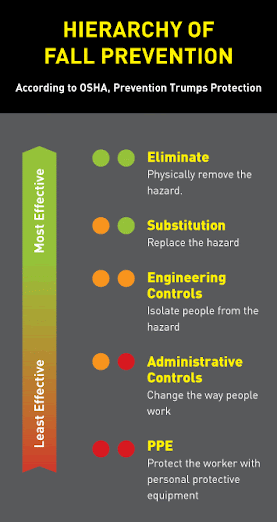
The Hierarchy of Fall Protection in Layman's Terms   Working at height can be hazardous and requires special equipment. Many governing bodies such as ANSI and OSHA set guidelines and regulations for these jobs, which may increase safety. Elimination (Stay on the Ground) Working at heights is a necessary aspect of many occupations yet can pose unique safety concerns. Therefore, it's vital that workers familiarize themselves with all available forms of fall protection systems and how they can be used to keep operators safe while performing their duties. Both ANSI and OSHA's Hierarchy of Hazard Controls state the initial step should be eliminating falling hazards from work environments - this means changing working environments, so employees aren't exposed to fall hazards to begin with, such as moving machinery onto the ground instead of the roof. While eliminating falls would always be preferable, sometimes this option simply isn't possible or could increase...

Designing A Corporate Safety Plan - Where to Begin?

Image
Safety First: How to Design a Corporate Safety Plan   Safety is a top priority for any company. But developing a safety plan requires more than just creating emergency documents and having lots of meetings, a good safety plan is a living document that grows with your company and its needs. Creating a strong safety policy requires thorough job hazard analysis and risk assessment. It also involves a system to onboard new employees and to reward safe behaviors. With a positive reinforcement program, you can encourage everyone to follow the company’s guidelines. Identifying Hazards To create a safety plan, you must first identify all the hazards in your workplace. You can do this by looking at the work environment and talking to workers. Consider each hazard and ask yourself two questions: How likely is the hazard to cause an incident, and how serious would it be if it did occur? Answering these questions will help you prioritize your hazard assessment and determine what co...

Safe Loading of Liquid Rail Cars - Best Practices

Image
Best Practices for the Safe Loading of Liquid Rail Cars Statistical analysis shows that 80% of transport-related accidents and incidents occur during loading and unloading operations. This guideline offers best practice advice on loading and unloading from an organizational and behavioral point of view. Drivers that access chemical sites for the purpose of (un)loading must follow site procedures in co-operation with their operators. These can involve working in flammable atmospheres. 1. Loading Procedures It is important to be familiar with all loading procedures and know the weight and pressure restrictions for each type of tank car. This allows the crew to be aware of all necessary precautions to take when loading and unloading. Loading/unloading operations should be attended and monitored by trained personnel or by an approved monitoring system. Do not allow the load/unload operation to stand unattended or unmonitored while connections are being attached. Before a tank car...

The Risks Of Offset Crashboxes/Operator Platforms To Workplace Safety

Image
Having the right fall prevention equipment in place is essential for preventing injuries and fatalities due to workplace accidents. When your rail cars feature dangerous offset crashboxes/operator platforms, it is even more important to implement safety solutions. A crashbox/operator platform is the built-in railing area that surrounds the hatch opening or valves on a rail car. An opening for workers to walk through may or may not be centered within the crashbox/operator platform. When the opening is not centered, the crashbox/operator platform is considered offset. In order to minimize the risks associated with offset crashboxes/operator platforms, you must first understand why they are dangerous, and then learn what workplace safety solutions to implement. The Dangers Of Offset Crashboxes/Operator Platforms When a crashbox/operator platform is offset, working conditions become more complicated for employees. Before accessing a hatch or valve, workers must line up the gangway with ...

Do Your Truck Spotting Practices Account For The Human Element?

Image
Investing in the right safety equipment is always a best practice. You want to mitigate the risk of injury or death for your customers and employees in a safer environment. But even months of planning and the best fall prevention systems may fail to address a critical safety component – the human element. Falls that cause serious injuries or even death are a vital reminder of the risk involved with loading trucks and the importance of safety. In the daily rush, it may be difficult for drivers and facility managers to imagine that such a tragic accident could happen. What is far more likely to be at the top of a driver’s mind each day is making a living – it’s human nature that drivers are going to look for workarounds to speed up the loading process and increase throughput. For facilities that are looking to safeguard their employees and their customers, here are some key tips to keep in mind. Parking Is The First And Most Important Step If a driver does not first park in the exa...

Aircraft Fall Prevention: Four Challenges and Three Safety Solutions

Image
Monitoring and maintaining a fleet of aircraft presents a number of ever-changing safety hazards at your hangar or facility. Furthermore, you face compliance challenges from not only OSHA, but also the FAA and your corporate office, and the aviation industry is one of the most highly regulated in the world in terms of safety. Yet, every minute your aircraft are on the ground, you’re losing money. So how do you clear these compliance hurdles while also reducing turnaround time on aircraft maintenance? You need the right safety solution that keeps workers moving efficiently while minimizing their exposure to harm. Here are the four biggest compliance challenges your facility must face – and three safety solutions to help you tackle them. Challenge #1: Corporate- & OSHA-Compliant Access When it comes to workplace safety for your aircraft maintenance employees, you have to be triple compliant. Not only is aircraft access regulated by OSHA, but also by Federal Aviation Administration ...

Is Your Loading Rack Due for an Overhaul?

Image
  4 Factors to Consider about Your Current Loading Rack The ability to safely load and unload materials is a must in truck and railcar environments. Unsafe conditions can lead to costly injuries that negatively impact the bottom line. Medical and workers’ compensation expenditures for fall-related injuries cost U.S. employers approximately $70 billion annually.  An up-to-date loading rack system can help keep workers safer and operations running smoothly. 4 Factors for Updating Your Loading Rack When is the right time to update your loading rack? Loading racks don’t have a “shelf life,” so you have to consider a variety of factors when deciding if it’s time to replace your current system. Factors to consider include: How old is the loading rack? Have your loading patterns, equipment, or access requirements changed? Are employees properly trained on safety procedures? Do they have access to documentation? Are workers aware of what the equipment was originally designed to ...

Measuring for Safety

Image
  Keep Operations Rolling and Employees Safer The key to successfully installing fall protection safety equipment is accurate measurement of the center line. As simple as this may sound, it is where companies often get into trouble and end up with equipment that doesn’t fit the application requirements. Three Steps to Get the Right Measurements 1. Establish the Center Line . Your design standard can be anything it needs to be, but establishing the center line is critical . These measurements are the basis of the drawings we send back to you for sign-off. When you measure, always begin from the center of the vehicle to the face of what you are mounting the access gangway on (see Figure 1). Ideally, you would position a vehicle in the loading area so that the measurement is spot on. If you are unable to position a vehicle in your facility due to the current restrictions, then you should measure where the truck(s) should line up, possibly marked by a stripe on the floor. For ra...